

May 24, 2026
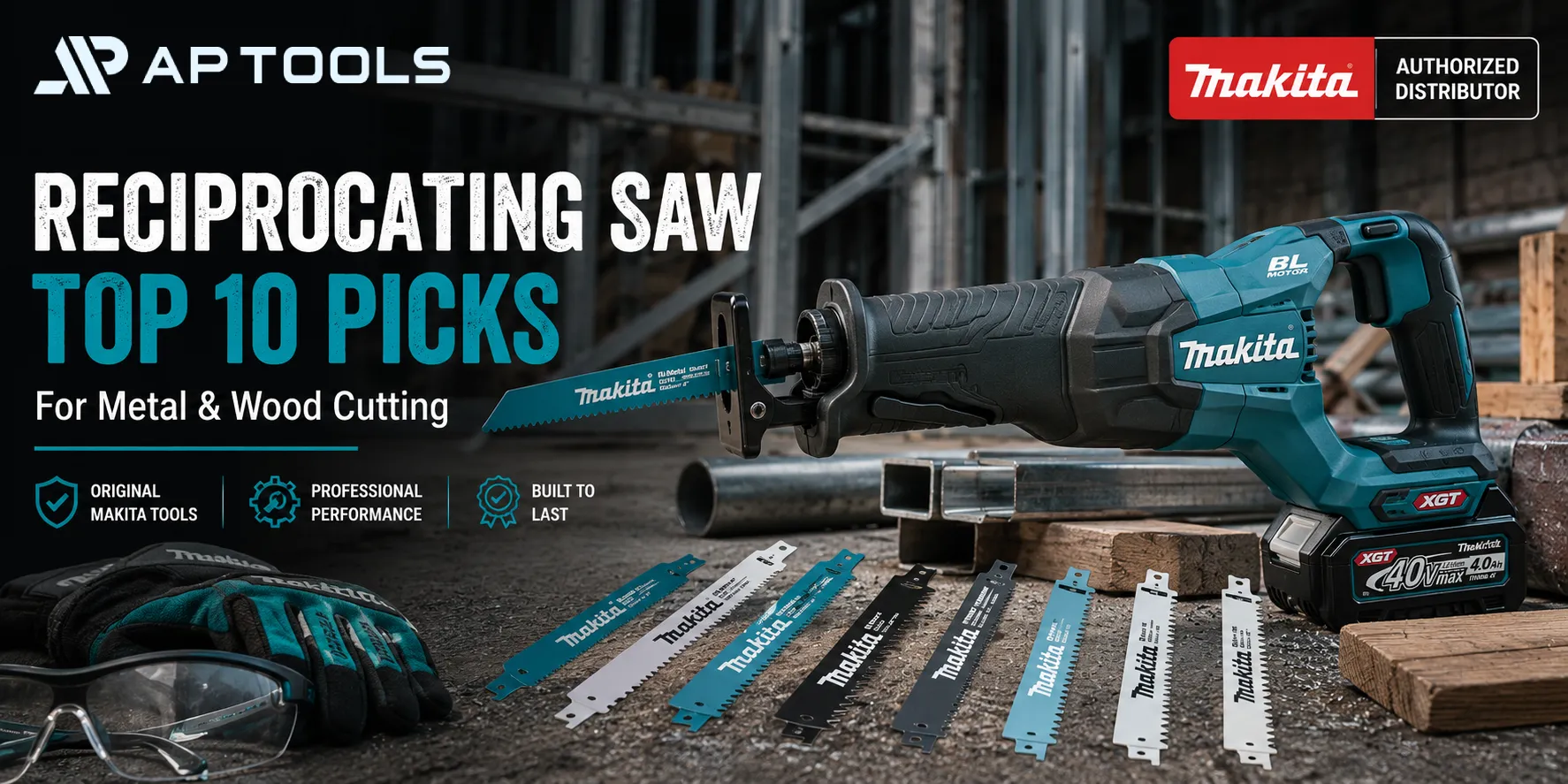
Reciprocating Saw: Our Top 10 Recommendations for Cutting Metal and Wood from AP Tools
The reciprocating saw is the tool you rarely think about until you need it—and when you do, nothing else can replace it. A pipe hidden behind a wall, a steel structure that needs cutting in a hard-to-reach location, selective demolition work where surrounding materials must remain intact, or a rusted metal rod in an outdoor area with no power source—these are the natural environments for a reciprocating saw. It reaches where other tools cannot and cuts what others struggle to handle.
However, choosing between dozens of models can be confusing. Corded or cordless? 18V or 40V? With AVT technology or without? Which blade is best for metal and which for wood? This guide answers those questions with specific recommendations: five genuine Makita reciprocating saws and five blade sets that complete your cutting solution for different materials. All products are available through AP Tools (Al Muhtarifoon Al Arab), the trusted and authorized Makita distributor in Saudi Arabia with more than 20 years of experience.
What Is a Reciprocating Saw and How Is It Different?
A reciprocating saw (also known as a Sabre Saw) is a power tool that cuts using a blade moving rapidly back and forth. It excels in tight spaces and can cut in almost any direction—forward, downward, and even behind walls. While it is not the most precise tool for straight cuts, it is unmatched for demolition and difficult-access applications.
- Cutting inside walls.
- Cutting pipes from both sides without extra clearance.
- Selective demolition while preserving surrounding materials.
- Fast rough cutting in field applications.
The three key specifications that determine performance are stroke length, strokes per minute (SPM), and power output or battery voltage in cordless models.
Quick Comparison Table
| Model | Type | Power | SPM | Weight | Key Advantage |
|---|---|---|---|---|---|
| JR3051TK | Corded | 1200W | 0–3000 | 3.3 kg | Reliable for daily use |
| JR3070CT | Corded | 1510W | 0–2800 | 4.6 kg | AVT + Orbital Action |
| DJR187Z | Cordless 18V | Brushless | 0–3000 | 3.4 kg | Lightweight, tool only |
| DJR187RTE | Cordless 18V | Brushless | 0–3000 | 3.4 kg | Complete kit with batteries |
| JR001GM2 | Cordless 40V | Brushless | 0–3000 | 3.5 kg | Most powerful cordless option |
Part 1: Corded Reciprocating Saws
Corded reciprocating saws provide consistent power from start to finish. There is no need to worry about battery charging or performance drops during long working hours, and they are generally more affordable than cordless alternatives in the same category.
Recommendation #1: Makita JR3051TK
Power: 1200W
Stroke Length: 30 mm
Speed: 0–3000 SPM
Weight: 3.3 kg
This is the standard reciprocating saw commonly found in workshops and construction sites. It is suitable for cutting wood, pipes, metal rods, and handling everyday demolition work. Features include tool-less blade changes and a dust-resistant design.
Recommendation #2: Makita JR3070CT
Power: 1510W
Stroke Length: 32 mm
Speed: 0–2800 SPM
Weight: 4.6 kg
Equipped with AVT (Anti-Vibration Technology) and orbital action, this model is ideal for professionals who work long hours and need greater comfort, improved control, and faster cutting performance, particularly in wood.
Part 2: Cordless Reciprocating Saws
Cordless models are more than a convenience—they are often the practical choice for open construction sites, rooftop work, behind-wall cutting, and other locations where power cords become a limitation.
Recommendation #3: Makita DJR187Z
A Brushless 18V reciprocating saw with a 32 mm stroke length, speeds up to 3000 SPM, and a weight of 3.4 kg. Sold as a tool-only package, making it ideal for users who already own Makita 18V LXT batteries.
Recommendation #4: Makita DJR187RTE
Offers the same performance as the DJR187Z but includes two 5.0Ah batteries and a fast charger. Perfect for users starting from scratch and looking for a complete ready-to-work solution.
Recommendation #5: Makita JR001GM2
Built on the Makita 40V XGT platform with a brushless motor and 32 mm stroke length. This is the most powerful model in this guide, designed for heavy-duty applications, thick metal cutting, and demanding job-site conditions.
Part 3: Blades – The Other Half of the Cutting Equation
The blade plays a major role in cutting performance. Choosing the correct blade directly affects cutting speed, edge quality, blade life, and operating temperature, especially when cutting metal.
Recommendation #6: Makita B-03030 Wood Blade
A 165 mm blade designed for wood and soft materials. Excellent for fast wood cutting, door demolition, and panel cutting applications.
Recommendation #7: Makita 792148-9 Wood Blade
Compatible with professional models such as the JR3050T, JR3060T, and JR3070CT. Designed to maximize stroke length efficiency and orbital action performance.
Recommendation #8: Makita 792146-3 Metal Blade
A 125 mm HSS blade designed for cutting steel, pipes, bolts, and metal materials. For best results, use at lower speeds and disable orbital action.
Recommendation #9: Multi-Purpose Bi-Metal Blade
Ideal for mixed materials such as wood with embedded nails or composite wall structures. While it may not be the best blade for every material, it offers excellent versatility.
Recommendation #10: Complete Blade Kit
For users who need maximum flexibility, a complete blade kit includes:
- Short wood blade.
- Long wood blade.
- Metal cutting blade.
- Multi-purpose blade.
Quick Decision Guide
- For workshops with reliable power: JR3051TK
- For intensive daily use: JR3070CT
- For users with existing 18V batteries: DJR187Z
- For new users starting from scratch: DJR187RTE
- For heavy-duty field applications: JR001GM2
Why Buy from AP Tools?
AP Tools (Al Muhtarifoon Al Arab) is the trusted and authorized Makita distributor in Saudi Arabia with over 20 years of experience. Purchasing from AP Tools ensures genuine products, manufacturer-backed support, and after-sales service through authorized service centers operated by its sister company, Rawad Al Madar.
Professional Usage Tips
- Use both front and rear handles for maximum stability.
- Do not force the tool—let the blade do the work.
- Take advantage of the adjustable shoe for better depth control.
- In hot climates, allow short cooling breaks during intensive use.
Frequently Asked Questions
What is the difference between a reciprocating saw and a jigsaw?
A reciprocating saw is designed for demolition, rough cutting, and difficult-access work, while a jigsaw is intended for precision cuts and curved shapes.
What is the difference between the JR3051TK and JR3070CT?
The JR3070CT is more powerful and includes AVT technology and orbital action, making it better suited for intensive and prolonged use.
What is the difference between the DJR187Z and DJR187RTE?
The DJR187Z is sold as a tool only, while the DJR187RTE includes two batteries and a charger.
Is the 40V platform worth the extra cost?
Yes, especially for professionals who frequently cut thick metal, heavy materials, and work in demanding field environments.
Which blade is best for metal cutting?
An HSS blade such as the Makita 792146-3 is recommended, used at lower speeds without orbital action.
Should orbital action always be used?
No. Orbital action is generally recommended for wood cutting but not for metal cutting.
Can a reciprocating saw cut concrete?
To a limited extent with specialized blades, but it is not the ideal tool for concrete cutting.
How long does a blade last?
Blade life depends on blade quality, material type, and operating technique.
Are cordless reciprocating saws suitable for Saudi Arabia's climate?
Yes, provided batteries are stored and charged correctly and protected from direct heat exposure.
How can I contact AP Tools?
Phone: +966 55 282 2719
Email: sales@aptools.sa
Website: https://aptools.sa
Conclusion
A reciprocating saw reaches places other tools cannot and handles cutting tasks that would otherwise be difficult or impossible. However, true performance starts with selecting the right model and blade combination. With these ten recommendations from AP Tools, you can confidently choose the best reciprocating saw solution for your workshop, construction site, or heavy-duty field applications.